Start Date: June 10, 2011
Finish Date: June 20, 2011
Well, this is the first lesson where I did not breeze through the "theory"and spend most of my time practicing the word lists and sentences. Two things slowed my progress. First, beginning X is made with the KP keys if the "X" is followed by a vowel of vowel sound. However, use final EBGS ("ex") in a separate stroke if "X" is followed by a consonant. Basically, KP is a shortcut to save a stroke. Second, beginning Z is made with the S and * keys. I had a hard time a first "reaching" with my right index finger to press the * key while pressing other keys (example: ZIP = S*EUP).
Here is a brief summary of Lesson #6:
Lesson #6:
Initial Side Letters: X C Z
Final Side Letters: X
Vowels: long U
Symbol: Asterisk Key
Brief Forms: ask, could, from, had, have, should, their, they, why, would
After 6 lessons:
* All initial and final letter have been covered
* 3 punctuation characters and 3 symbols have been covered
* 41 brief forms have been covered
Wednesday, June 22, 2011

Friday, June 17, 2011
Case CATalyst on Mac OS X
Personally, I don't know if there is any CAT software for Mac. When I bought my Elan Cybra, it came with Case CATalyst version 10 for the PC. So I decided to see if I could install it on my MacBook Pro (Intel Core i5, Mac OS X version 10.6.7). I already had installed VirtualBox on my Mac (with Windows XP) to run Windows software, if necessary.
Please note that Case CATalyst only recommends installing Case CATalyst on BootCamp and does not recommend installing Case CATalyst on a virtual machine like Parallels Desktop or VMware Fusion (or VirtualBox).
However, I have been able to install the Case CATalyst software on VirtualBox, connect the blue security device and my Elan Cybra (and the Stentura 400 SRT) to my Mac and Case CATalyst program without any noticeable problem. I must note that I am new to the program and have not tried all aspects of the program. But it seems to work just fine.
Please note that Case CATalyst only recommends installing Case CATalyst on BootCamp and does not recommend installing Case CATalyst on a virtual machine like Parallels Desktop or VMware Fusion (or VirtualBox).
However, I have been able to install the Case CATalyst software on VirtualBox, connect the blue security device and my Elan Cybra (and the Stentura 400 SRT) to my Mac and Case CATalyst program without any noticeable problem. I must note that I am new to the program and have not tried all aspects of the program. But it seems to work just fine.
Wednesday, June 15, 2011
Court Reporting at Home (CRAH) -- Lesson 5
Start Date: June 6, 2011
Finish Date: June 10, 2011
Finish Date: June 10, 2011
I finished CRAH Lesson #5 in less than a week, though I have to admit that I went through the material once (or twice) while doing lesson #4. While a person is not suppose to look ahead in the lesson manual, I will read the next lesson if I find myself doing the practice lessons a bunch of times. Here is a basic summary of Lesson #5:
Lesson #5:
Initial Side Letters: V Q G
Final Side Letters: Z J
Vowels: long O
Brief Forms: can, many, were, when, where, whether, which, with, yes
Sunday, June 12, 2011
After One Month with CRAH
After one month with the CRAH program, I have completed 4 lessons.
I think that I'm an average (skilled) person and only have about 1/2 hour to 1 hour to practice each day, and I do miss a day here and there. At this rate, I am completing about a lesson a week and it will take me about 5 months to complete the 20 lessons of theory.
Therefore, the people that you read about on the CRAH website who finish the theory in about 3 months are probably practicing about 2 or more hours per day, which is not unusual for (full time) court reporting student.
I think that I'm an average (skilled) person and only have about 1/2 hour to 1 hour to practice each day, and I do miss a day here and there. At this rate, I am completing about a lesson a week and it will take me about 5 months to complete the 20 lessons of theory.
Therefore, the people that you read about on the CRAH website who finish the theory in about 3 months are probably practicing about 2 or more hours per day, which is not unusual for (full time) court reporting student.
Friday, June 10, 2011
Court Reporting at Home (CRAH) -- Lesson 4
I finished CRAH Lesson #4 in about a week and a half, though I think that it would taken me only a week if I practiced everyday for an hour. For this lesson, I was only able to practice for about 1/2 a day, but I was unable to practice everyday. Here is a basic summary of Lesson #4
Lesson #4:
Initial Side Letters: J Y W F K
Final Side Letters: F M K
Vowels: long I
Symbols: "Q:" and "A:"
Brief Forms: be, because, did, if, that, there, this, what
Similar to Lesson #3, I could not keep up with the dictation CD after doing the practice words and sentences about 20 times. I think that I did them again another 10 times or so and could almost keep up, so I did them a few more times and was finally able to follow the dictation CD, though I did make errors.
Saturday, June 4, 2011
New Steno Machine -- Elan Cybra
When I was originally looking for a Steno Machine, I had considered getting an Elan Cybra, a paperless machine. They were a bit more expensive and I had read that you really don't need a paperless machine until you finish the basic theory and a person needs the ability to read the "raw" steno notes.
But it occurred to me that I would eventually be connected to a computer where it would be translating my input into English in realtime. On top of that, I could save money on ink and paper.
So I decided to purchase an Elan Cybra. I would use both of them out and then sell the one I did not like on eBay. After using the Elan Cybra for a few weeks, I generally like it a bit better than the Stentura 400 SRT, but I have not yet decided if I want to sell the Stentura 400 SRT.
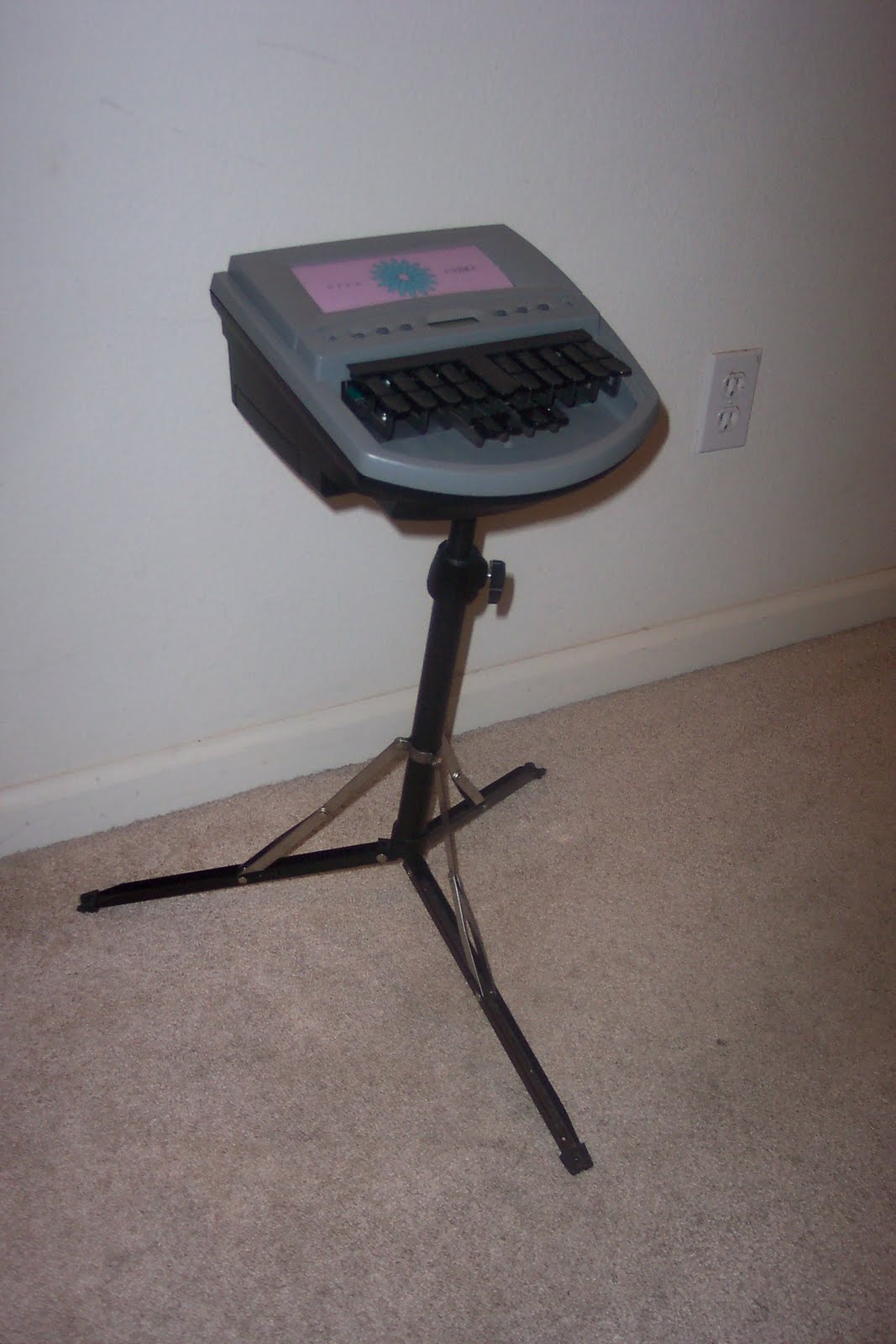

(Note: the previous owner put some non-slip pads on the keys. I really didn't like them, so I removed most of them. I left the non-slip pads on the asterisk key and the number bar to help me with one of my ealry problems: my finger drifting from the home position)
Pros:
* Paperless. No paper or ink to deal with.
* Made in 2009. More modern than the Stentura 400 SRT.
* The keys are more adjustable.
Cons:
* Must be connected to a computer to be meaningful. This means I had to learn the CAT program (all by myself). I would eventually have to learn it with the Stentura 400 SRT, but I had to use valuable practice time to learn the CAT program.
* More expensive than the Stentura 400 SRT, though I got it for a a good price on eBay.
Friday, June 3, 2011
Court Reporting at Home (CRAH) -- Lesson 3
Well, it took me a bit more than a week to complete CRAH Lesson #3. I continue to only practicing about 1/2 to 1 hour per day. I spent the other time setting up and learning the basics of the Computer Aided Translation (CAT) software. Here is a basic summary of Lesson #3
Lesson #3:
Initial Side Letters: D B M H
Final Side Letters: D B G
Vowels: long E
Punctuation: ","
Brief Forms: also, always, any, in, knew, how, will
Just like Lesson #2, what took me so long too complete this lesson were the practice words (about 92) and the practice sentences (about 13). I could do them slowly, but once again I could not keep up with the dictation CD. So if you're like me, don't be shocked if you breeze through the beginning of the lesson--new letters and brief forms--and spend most of your time practicing the words and sentences.
Tuesday, May 31, 2011
Court Reporting at Home (CRAH) -- Lesson 2
Well, it took me a little less than a week to complete CRAH Lesson #2. I have to admit that I'm only practicing about 1/2 to 1 hour per day, but this seems all that I have time for right now. I had an easy time with the new letters and brief forms. Here is a basic summary of Lesson #2
Lesson #2:
Initial Side Letters: P L N
Final Side Letters: P L N
Vowels: long A
Punctuation: "?"
Brief Forms: are, he, I, is, it, the, you
(For Steno Machine Basics, click here)
What took me so long too complete the lesson were the practice words (about 45) and the practice sentences (about 16). I could do them slowly, but I could not keep up with the dictation CD. The Lesson Manual said to practice the words and sentences 5 time each. I recommend at least 10 times each, and it probably took me about 20 times each before I was able to follow along with the dictation CD.
Lesson #2:
Initial Side Letters: P L N
Final Side Letters: P L N
Vowels: long A
Punctuation: "?"
Brief Forms: are, he, I, is, it, the, you
(For Steno Machine Basics, click here)
What took me so long too complete the lesson were the practice words (about 45) and the practice sentences (about 16). I could do them slowly, but I could not keep up with the dictation CD. The Lesson Manual said to practice the words and sentences 5 time each. I recommend at least 10 times each, and it probably took me about 20 times each before I was able to follow along with the dictation CD.
Saturday, May 28, 2011
Court Reporting at Home (CRAH) -- Lesson 1
I started the Court Reporting at Home (CRAH) program on about May 7, 2011.
I watch the DVD lesson and read through Lesson 1 in the manual. The lesson basically covers some initial and final letter and the short vowels. Here is an outline of Lesson #1:
Lesson #1
I watch the DVD lesson and read through Lesson 1 in the manual. The lesson basically covers some initial and final letter and the short vowels. Here is an outline of Lesson #1:
Lesson #1
Initial Side Letter: S T R
Final Side Letters: S T R
Vowels Sounds: short A, short O, short E, short U, short I (press E & U)
Punctuation: "."
Brief Forms: None
Because I had already completed several lessons in the Phoenix Theory manual, I was able to complete the Lesson within an hour or two.
A Note on Vowel sounds:
Vowels sounds are either long or short. All long vowels sound like the letter. Short vowel sounds do NOT sound like the letter and the pronunciation sound is like adding an "h" to the letter. Examples:
kit = short I (sounds like "ih")
kite = long I (sounds like the letter "I")
back = short A (sounds like "ah")
bake = long A (sounds like "A")
net = short E (sounds like "eh")
neat = long E (sounds like "E")
not = short O (sounds like "oh")
note = long O (sounds like "O")
nut = short U (sounds like "uh")
cute = long U (sounds like "U")
Monday, May 23, 2011
What I don't Recommend for Learning the Steno Machine


Before I purchased the Court Reporting at Home (CRAH) program. I figured that I would buy some text books and a steno machine and teach myself. While I don't doubt that I could have succeeded, I now realize that this could have been a long, hard road.
Recommended: A developed program of study. Either through a vocational school (very expensive) or a home study program (much less expensive).
Not Recommended: Buying the text (theory) books and steno machine yourself and being purely self taught.
Before CRAH:
Steno Theory:
I discovered that there were several Steno machine theories: Phoenix; Sten Ed; Roberts, Walsh, and Gonzalez; Stenomaster; etc. Theory is fundamentally how to write on the steno machine but also includes how to write on the steno machine so that court reporting software can translate your typing in realtime into English so that everyone can read it.
I became partial to the Phoenix theory and bought 2 theory used books on eBay for about $20.
Steno Machine:
I also read about Steno Machines, and my conclusion was that I should buy either a Stentura 500, a Stentura 400 SRT, and elan Cybra (Student model by Stenograph), or a Stentura 200 SRT. All these models can connect to a computer--indicated by the SRT on the Stentura models. The elan Cybra is a more expensive "paperless" writer (saving you money in paper and ink but costs more and but to be connected to a computer).
I bought a used Stenura 400 SRT on eBay for about $600.
Dictation CDs:
In the Phoenix theory books I noticed dictation exercises which I did not have. I soon realized that these were important if I wanted to learn the steno machine and increase my speed. So I bought the exercise CD and some other related material on eBay. (So at this point I have a little less than $700 invested in my new career).
I then noted that I was starting to put together my own program and realized that an established program would be much better. After some research, that's when I determined that the best study at home program was Court Reporting at Home (CRAH).
Subscribe to:
Posts (Atom)